Design & prototyping
of thermoplastic parts
Design and prototyping determine a product’s industrial success.

Design and prototyping determine a product’s industrial success. At Plastitec, these stages take place very early on to turn a functional need into a reliable, controlled solution ready for industrialisation, integrating production constraints from the very start of the project.
Design of thermoplastic parts and tooling
From the very first stages, Plastitec helps customers design parts and tools suited to thermoplastic injection moulding.
An integrated design office to support you
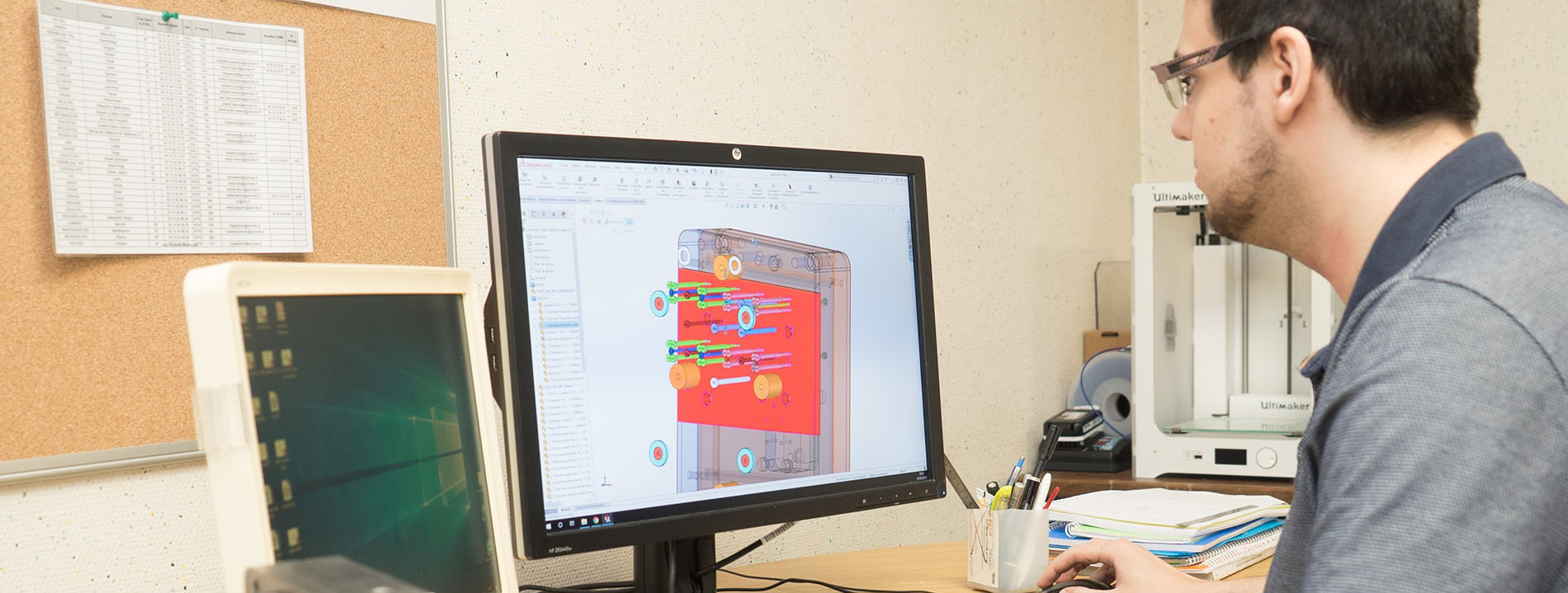
Plastitec works with the Arindis Group design office, in close cooperation with the production, tooling and quality teams. Our engineers and technicians analyse, challenge and optimise technical choices to anticipate industrial constraints upstream.
Each project is managed by a dedicated project manager, your single point of contact, who coordinates internal expertise and ensures continuity from development through to industrialisation.
Design driven by industrialisation
At Plastitec, design is inseparable from production. We take a pragmatic, results-oriented approach:
- Reverse engineering of existing parts or tools
- Co-design of thermoplastic parts and tooling
- Project studies and technical proposals during industrialisation
- Optimal selection of raw materials
- Support for switching production to recycled materials
This approach secures technical choices and efficiently prepares the tooling and series production stages.
Simulation and process optimisation
Before a tool is launched, the design office uses mould flow analysis to anticipate material behaviour and optimise part and mould design. Rheological studies identify risks of warpage, sink marks or cosmetic defects upstream, limiting adjustments at start-up.
We use industry-recognised software such as SolidWorks for 3D design and Cadmould for mould flow simulation and material flow optimisation.
Prototyping parts and tools before industrialisation
Prototyping is a crucial step in product development. It allows a concept to be tested against real-life use, technical choices to be refined and the next project stages to be guided before industrialisation.
Fast prototyping to validate technical choices
Plastitec offers fast prototyping, drawing on the Arindis Group 3D printing workshop to produce functional prototypes within short lead times. These trials allow parts to be tested, their mechanical behaviour analysed and the design adjusted before the tooling and production stages.
Complementary 3D printing technologies
We use several 3D printing technologies to meet varied needs in terms of functionality, precision or appearance:
- Fused filament fabrication (FFF): fast functional validation
- Selective laser sintering (SLS): strong parts and complex geometries
- Stereolithography (SLA): high precision and refined finish
- Digital Light Processing (DLP): detailed, aesthetic prototypes
- Multi Jet Fusion (MJF): functional prototypes and small series
Prototyping beyond plastic parts
Our prototyping expertise also extends to prototype tools and special machines, depending on the specific constraints of each project.
Design solutions tailored to your sectors
Plastitec’s design and prototyping expertise applies to a wide range of industrial sectors with high technical and regulatory requirements:
- Building & home automation: technical parts and equipment components
- Protection & safety: functional parts subject to regulatory standards
- Energy & transport: components requiring robustness and reliability
- Healthcare & leisure: parts with high cosmetic and repeatability requirements
- Robotics & automation: precision components integrated into complex systems
This diversity illustrates Plastitec’s ability to adapt its design solutions to the most demanding environments of use.
Have a project? Let’s talk.
Our teams are ready to study your project and offer you
a solution tailored to your technical and industrial constraints.
